Why cold email teams end up managing so many domains and inboxes
The technical reason high-volume mailbox setups become complicated long before the campaign itself does.
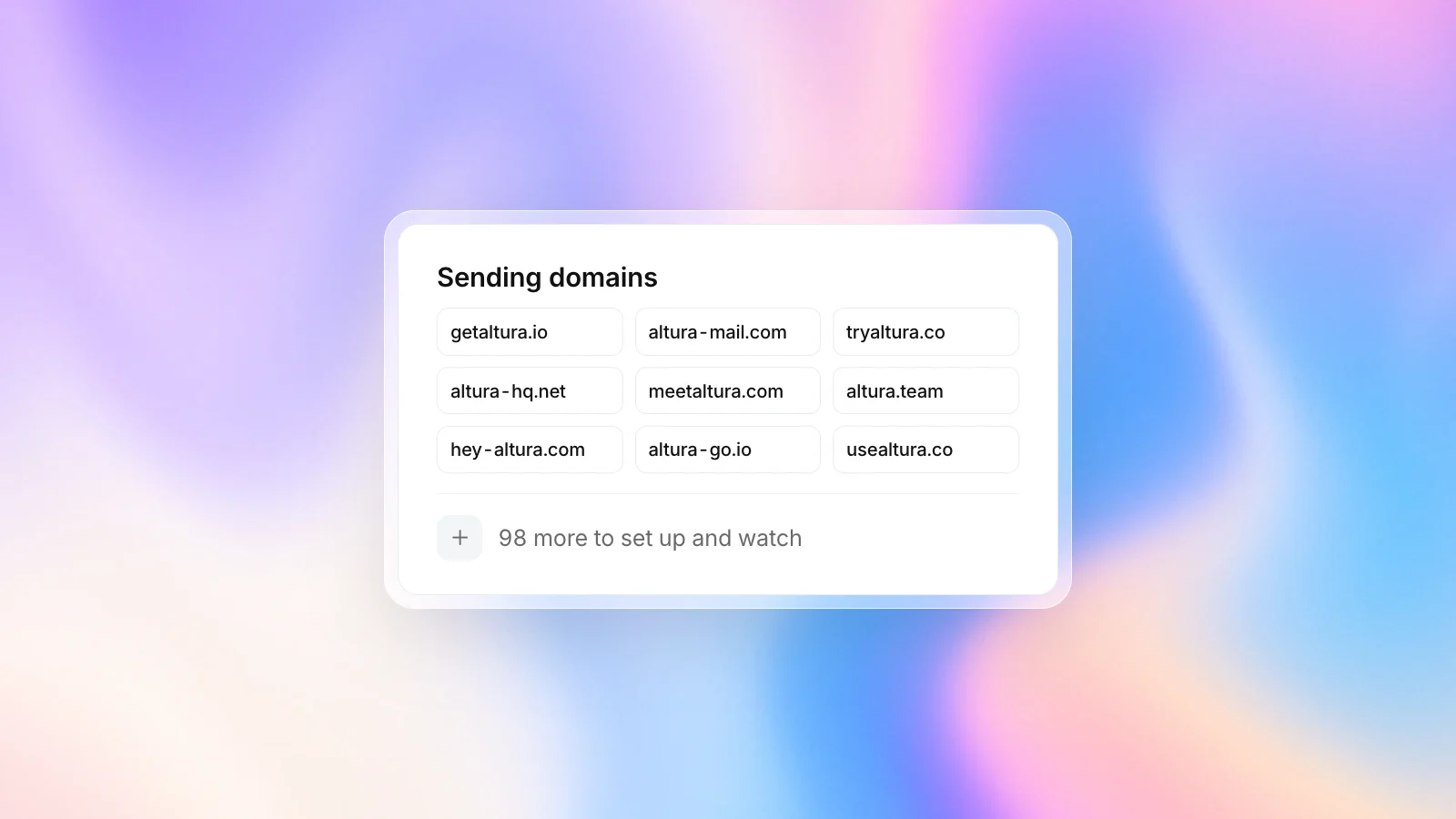

Nobody chooses to run a hundred domains. It is what a per-mailbox ceiling produces once you multiply it by the volume you need.
Understanding why the sprawl happens explains why adding more of it does not fix it.
It starts with one number
A cold-outreach mailbox is practically limited to roughly 20 to 50 sends a day. That is not a published quota, it is where operators find the mailbox survives.
Every other complication in a farm setup follows from that single constraint. If mailboxes could safely send a thousand a day, none of the rest of this would exist.
Multiplication does the rest
Ten thousand a day at thirty per mailbox is about 333 mailboxes. Those cannot all sit on one domain, because a domain-level problem would take out the entire operation at once.
At three to five per domain, that is 70 to 110 domains. Each needs purchasing, pointing somewhere, authenticating, and then keeping correct while it ages.
Why the spreading is deliberate
Distributing mailboxes across many domains is a containment strategy. It means a reputation problem on one domain costs you a slice of capacity rather than all of it.
It is a reasonable response to the constraint. It is also the thing that turns outbound into an administrative job, because each additional domain is an independent thing to configure and monitor.
What the sprawl costs to maintain
A hundred domains is a hundred SPF records that can exceed their lookup limit, a hundred DKIM keys that can be rotated inconsistently, a hundred DMARC policies that can sit unreviewed, and a hundred registrations that can lapse.
None of these break loudly. They degrade, and the symptom is a slow decline in performance on some domains that nobody can immediately explain.
Why more of the same does not help
When volume needs to grow, the farm model offers exactly one lever: add mailboxes, and therefore domains. Every pull of that lever increases the administrative load proportionally.
That is why the sprawl feels like it cannot be solved from inside the model. It cannot. It is the model working as designed.
Changing the shape means moving volume behind infrastructure whose capacity rises with its reputation, so growth stops requiring linear manual effort. That trade costs you a ramp measured in weeks, which is a real price and worth naming before you pay it.


Send 10,000 cold emails a day without renting a single inbox.
Your own dedicated IPs on isolated sending infrastructure, provisioned and warmed for you. One flat price.